care
Mag Drill Safety Chain and Vertical Use: Planning the Setup
Vertical drilling needs an approved complete setup, not simply a drill that sticks to steel. Establish the machine's permitted orientation, workholding, secondary restraint and access before starting. If the arrangement cannot be confirmed from the manual, obtain manufacturer guidance.
As an Amazon Associate I earn from qualifying purchases. Links marked “Check Amazon” are affiliate links.
Define the orientation precisely
Write down whether the drill rests upright on a horizontal plate, attaches to a vertical face or hangs beneath a workpiece. These positions can be confused in casual descriptions. A simple sketch helps support staff understand the actual proposed operation.
Also describe the workpiece support and the space behind the intended hole. Planning must account for people and equipment around the operation, not only the person holding the feed handle. Do not perform a trial cut to discover where waste material will fall.
Read the restraint instructions for the exact model
The Milwaukee 2787/2788 operator manual includes specific strap requirements, including inspection for damaged webbing and protection from sharp edges. Read the complete attachment instructions for those models. Do not transfer a strap route from another brand simply because the carrying handles look similar.
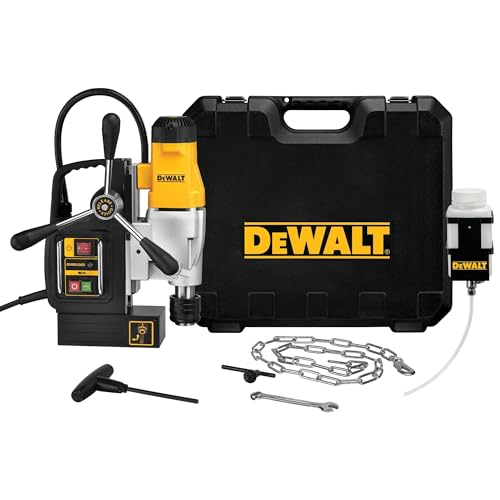
Identify every component by its intended purpose. A carrying handle, transport strap and safety restraint are not interchangeable categories. Replacement restraint compatibility should come from the manufacturer rather than a visual match in an online listing.
- Check that the manual permits the proposed orientation.
- Identify the approved restraint and attachment arrangement.
- Resolve the cutter, slug and chip paths before positioning anyone nearby.
Inspect the selected Amazon offer
Check model, regional version, included accessories and current seller details before ordering.
Check AmazonRecognize when the job needs a different method
If the required attachment cannot be made or the workpiece falls outside the drill's documented limits, reconsider the equipment or fixture. Adding more improvised straps does not demonstrate that the mounting surface is acceptable. A secondary restraint does not create additional cutting capacity.
Ask the manufacturer to assess the complete proposal, including material, thickness, surface shape, orientation and lubrication arrangement. For workplace operations, include the responsible supervisor or competent person in the decision. The useful outcome is a documented suitable setup, which may involve another machine rather than permission to force the current one into the job.
Questions, answered
Does a permanent magnet remove the need for a restraint?
Do not assume so. Follow the exact model's secondary-restraint requirements regardless of how its magnet is powered.
Can a chain compensate for unsuitable material?
No. The complete mounting and workholding arrangement still has to meet the manufacturer's requirements.