Working in tight spaces?
A low-profile body changes where the drill fits. Check the cutter system and access for the handle, not just the advertised height.
Explore low-profile drillsThe magnetic drilling field guide
A mag drill—also called a magnetic drill press—brings a supported drilling system to suitable ferrous work that is too large or fixed in place to take to a shop drill press. Start with the hole, mounting surface and access; then compare the machine.
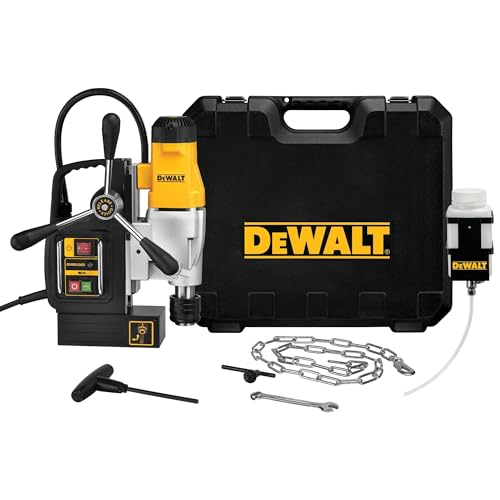
2-inch annular capacity. Two spindle speeds. An included twist-drill chuck. Check the complete package against your job.
Read the model guideAs an Amazon Associate I earn from qualifying purchases. Links marked “Check Amazon” are affiliate links.
A magnetic drill carries its own feed mechanism and magnetic base to the steel workpiece. With an annular cutter it removes a ring of material and leaves a slug, which can make it practical for larger holes in fabrication, structural steel and repair work when the exact machine and setup permit the job.
It is not a universal drill for every metal or surface. Aluminum, thin material, pipe, coated or uneven steel, overhead work and twist drilling each introduce separate attachment, restraint, tooling or orientation questions. If the exact manual does not approve the setup, a strong magnetic-force headline does not make it suitable.
A low-profile body changes where the drill fits. Check the cutter system and access for the handle, not just the advertised height.
Explore low-profile drillsCompare the complete cordless kit with a corded setup. Battery freedom and magnetic-base design are separate decisions.
Compare power optionsMatch the shank system, diameter, cutting depth and pilot pin. “Mag drill bit” is not a universal compatibility label.
Check cutter systemsThese figures describe annular cutting. They do not establish twist-drill capacity, mounting suitability or permitted cutter material. RPM conditions differ where noted.
As an Amazon Associate I earn from qualifying purchases. Links marked “Check Amazon” are affiliate links.
| Model | Annular diameter | Depth | Speed | Power | Offer |
|---|---|---|---|---|---|
| DEWALT DWE1622K | 2″ | 2″ | 300/450 no-load | corded | Check Amazon |
| Hougen HMD904 | 1.5″ | 2″ | 450 | corded | Check Amazon |
| Hougen HMD130 | 1.375″ | 1″ | 450 | corded | Check Amazon |
| Hougen HMD905 | 2″ | 2″ | 250/450 | corded | Check Amazon |
| Evolution EVOMAG42 | 1.625″ | 2″ | 450 no-load; one speed | corded | Check Amazon |
| Evolution S28MAG | 1.125″ | 2″ | 450 no-load; one speed | corded | Check Amazon |
| Makita HB350 | 1.375″ | 2″ | 850 | corded | Check Amazon |
| FEIN JME ShortSlugger II | 1.25″ | 2″ | 700 no-load; 450 full-load | corded | Check Amazon |
Smaller-capacity corded, general fabrication, and battery-powered options. These are starting points for comparison, not a ranked performance test.
As an Amazon Associate I earn from qualifying purchases. Links marked “Check Amazon” are affiliate links.
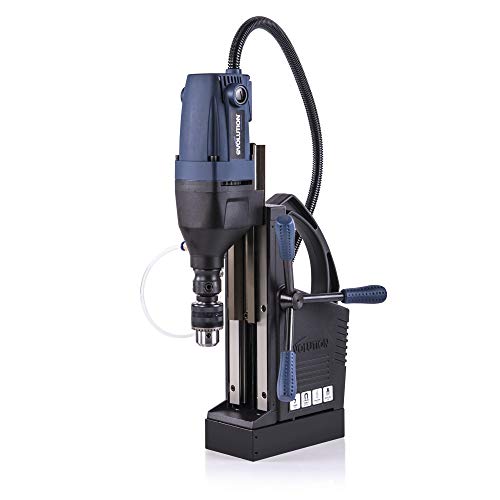 Model guide available
a compact-capacity corded drill for hole schedules that stay within its 1-1/8-inch annular diameter limit
The 2-inch depth figure is separate from diameter, and a 2-inch cutter is not automatically a 2-inch-diameter cutter. Evolution specifies a 3/8-inch minimum plate thickness. The published magnetic adhesion figure is not a lifting capacity or a reason to ignore that minimum.
Check Amazon Model guide available
a general fabrication model whose part-number differences matter almost as much as its headline capacity
The newer permanent-magnet HMD904 is a distinct configuration, not a feature to assign to every HMD904. Likewise, swivel models have different weights and magnetic force figures. A product card should identify the exact configuration instead of combining the most attractive attributes across the range.
Check Amazon Model guide available
a cordless 1-1/2-inch drill whose purchase economics depend heavily on the batteries and charger already in your workshop
Milwaukee now marks 2787-22 no longer available, while its current kit page's in-the-box area shows only the 2787-20 tool. The retained offer is exact by model name but does not prove current stock or package contents; verify batteries, charger and accessories with the seller.
Check AmazonStart with the exact model's permitted material, minimum thickness, contact area, surface condition and safety restraint. Paint, scale, gaps, curvature and non-ferrous stock can change the setup. If this gate fails, more motor power or cutter capacity does not rescue the choice.
Record material, finished diameter, required cutting depth and hole count. Keep annular diameter, cutting depth, machine stroke and twist-drill capacity separate. Then match the cutter interface, pilot system and material guidance instead of treating every “mag drill bit” as interchangeable.
Check the drill's operating height, body width, feed-handle sweep, cutter projection and room to retrieve the slug. A low-profile HMD130 can solve an access problem, but its RotaLoc Plus interface and 1-inch cutting-depth limit make it a different system from a full-size Weldon-shank drill.
Compare corded supply and extension requirements with the complete cordless battery/charger package. Then check the exact speed arrangement, restart behavior and orientation rules. “Cordless,” “two-speed” and “permanent magnet” describe separate decisions, not an automatic hierarchy.
Count the machine, correct cutters, pilot pins, approved lubricant, chuck or adapter, battery and charger, case and any model-required accessories. Similar model numbers can hide different kits; a basic machine and a swivel-base or Fabricator package are not like-for-like purchases.
A conventional drill press may be simpler when the workpiece is portable and repeatable bench setup matters. A handheld drill may suit smaller permitted work. Pipe, non-ferrous stock and line-boring intent need purpose-approved fixtures or systems rather than an improvised magnetic-base setup. The best mag drill is the one that passes every required gate—not the one with the largest headline number.
Compare magnetic drill presses by documented capacity, power and cutter system. Separate exact models from bundles and marketplace variants.
Choose a magnetic drill around the work you actually need to do: hole diameter, depth, access, power and total package cost.
Choose mag drill bits by cutter interface, cutting depth, pilot arrangement, material and the exact limits of your magnetic drill.
Compare drilling methods and machine features with practical tradeoffs, exact-model evidence and clear purchasing checks.
Plan magnetic drilling work with accurate capacity distinctions, mounting requirements and manufacturer-backed guidance.
Identify common magnetic drill symptoms, safe checks and the point where the operator manual or qualified service is needed.
Keep magnetic drills and cutters ready for work with cleaning, storage and maintenance guidance tied to manufacturer instructions.
Compare a magnetic drill with a stationary drill press by workpiece size, setup, cutter capacity, material and total equipment cost.
Find value in a budget magnetic drill by checking required capacity, complete accessories, documentation and service before price.
Compare HSS and carbide annular cutters by exact material, speed, shank, depth, pilot and documented service-life conditions.
Distinguish Weldon, double-flat, straight and bayonet cutter records, then match the exact pilot and approved adapter direction.
Compare exact-model minimum steel requirements, full-base contact and thin-plate stop rules before selecting a magnetic drill.
Separate thin, dirty or partial contact from cutter-load problems and a possible magnet fault before restarting a mag drill.
A mag drill brings a supported drilling system to large steel workpieces that are awkward to move to a bench drill press. Its magnetic base attaches to suitable ferrous material, while an annular cutter removes a ring of metal and leaves a slug. Mounting, restraint and cutter requirements still come from the exact manual.
A mag drill uses a magnetic base and feed mechanism to support the cutting operation on suitable steel. A handheld drill is held and fed by the operator. A conventional drill press stays on a bench or stand and usually requires bringing the workpiece to the machine.
There is no single best brand for every job. Compare documented models from DEWALT, Hougen, Evolution, Milwaukee, FEIN and Makita against the required diameter, depth, power source and clearance. Package contents and cutter compatibility can matter more than the brand name.
Cost depends on capacity, power system, accessories and the exact offer. Compare the complete working package: machine, cutters, pins, approved lubricant and any required batteries or adapters. Check current Amazon offers through the product links; this site does not maintain live prices.
Use the exact model’s annular diameter rating and the cutter’s approved material limits. For example, the Evolution S28MAG is rated up to 1-1/8 inches in annular diameter, while the DEWALT DWE1622K is rated up to 2 inches. Cutting depth and twist-drill diameter are separate limits.
Common symptoms include weak magnetic attachment, a cutter that will not cut, poor coolant flow, a trapped slug, rough holes and a motor that will not start. Stop and identify the cause before continuing; our troubleshooting guides distinguish operator checks from repairs requiring qualified service.
Only if the exact machine, tapping attachment and operating method are approved for it. A machine that accepts annular cutters is not automatically rated for tapping, and reverse rotation alone does not establish a complete tapping setup.
Some models support twist drilling with a specified chuck and adapter. Confirm the permitted bit capacity, arbor, travel and clearance. A 2-inch annular rating does not mean a 2-inch twist drill is permitted.
Only follow an orientation that the exact manufacturer permits, with its specified restraint and lubrication method. Overhead use changes the falling-tool, hot-slug and liquid hazards. Do not assume a strong magnet or permanent-magnet base makes an overhead setup safe.
An annular cutter generally uses a pilot pin for positioning and, depending on the system, coolant control and slug ejection. A pilot pin is not the same as pre-drilling a pilot hole. Follow the cutter manufacturer’s instructions; other tooling may use a different hole-preparation method.
A standard mag drill is not automatically a line-boring system. Coaxial bores require controlled alignment, support, tooling and tolerances. Use equipment explicitly designed and approved for that task rather than improvising lateral cutting with an annular drill.
It can be useful when the workpiece is too large or fixed in place to bring to a conventional drill press, provided a suitable mounting surface and safe setup are available. For portable small parts or occasional small holes, another drilling method may be more appropriate.
Weight varies by model and configuration. Compare the exact manufacturer’s machine weight and the full carrying package, including batteries, cutters and case. Low-profile describes access geometry and does not necessarily mean the lightest complete setup.
Evolution S28MAG specifications · Hougen HMD904 configurations · DEWALT DWE1622K · Milwaukee 2787/2788 manual