guides
Mag Drill Minimum Steel Thickness: Exact-Model Checks
Minimum steel thickness belongs to the mounting system, not the cutter. It is different from cutting depth and cannot be replaced by a high magnetic-force headline. Measure the material under the whole base, then apply the exact drill's surface, contact, restraint and orientation requirements before treating the setup as eligible.
As an Amazon Associate I earn from qualifying purchases. Links marked “Check Amazon” are affiliate links.
Start with exact-model boundaries
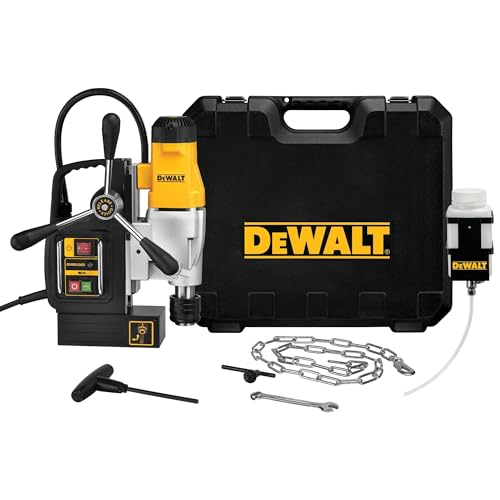
DEWALT's DWE1622K manual requires flat steel at least 3/8 inch thick with no visible air gap. Evolution's current US S28MAG page also lists a 3/8-inch minimum plate thickness. Hougen's general FAQ uses 3/8 inch as its minimum guidance, while HMD130 instructions call for clean, flat steel at least 3/8 inch thick and additional mechanical clamping at 3/8 inch or thinner or on an uneven surface.
Those statements do not create a portfolio-wide 3/8-inch approval. The retained DCD1623 evidence, for example, does not establish a minimum mounting thickness, so its value remains unknown here. A model without a verified number must not inherit one from a different DEWALT or another brand.
- DWE1622K: at least 3/8-inch flat steel, no visible air gap.
- Evolution S28MAG: current US page lists 3/8-inch minimum plate thickness.
- Hougen HMD130: clean flat steel at least 3/8 inch; follow its extra clamping instruction at the boundary or on uneven material.
- DEWALT DCD1623: exact minimum remains unresolved in retained primary evidence.
Measure the steel that supports the whole base
The hole location and the magnet footprint may not sit over the same material condition. Record the measured thickness beneath the entire base as well as the thickness to be cut. An edge, weld, step, curve or nearby opening can leave part of the magnet unsupported even when the drawing's nominal plate thickness exceeds a published minimum.
Hougen identifies paint or coatings, chips, dirt, grease, curvature and partial base contact as holding losses. The DWE1622K adds a no-visible-air-gap condition. A sufficiently thick plate does not cancel those limits, and cleaning the base does not turn aluminum or non-magnetic stainless into a direct magnetic surface.
Inspect the selected Amazon offer
Check model, regional version, included accessories and current seller details before ordering.
Check AmazonRead holding-force figures with their test plate
Hougen's HMD904 page makes the thickness effect visible: its standard base lists 1,750 pounds dead lift on 1-inch plate and 1,310 pounds on 3/8-inch plate. The same page lists different figures for the swivel base. These are manufacturer test figures, not a prediction of holding force on your coating, curve, partial footprint or actual job.
Compare force numbers only when the plate thickness, base version and test definition are stated. An indicator, lift-protection circuit or safety chain does not approve the workpiece. Restraint limits the consequences of movement; it does not repair insufficient magnetic contact.
- Confirm the model-specific minimum thickness.
- Check contact beneath the entire magnetic base.
- Identify coatings, contamination and curved surfaces.
- Resolve unsupported mounting before choosing a cutter.
Apply the thin-steel stop rule
Pass only when the exact model's minimum thickness, complete base contact, surface condition, orientation and required restraint or fixture are all established for the proposed location. If the material is below the model limit—or the model limit remains unknown—stop the direct-mount shortlist. Do not substitute more motor power, a deeper cutter or an unverified backing plate.
For a thin or unresolved job, send the manufacturer the exact drill, grade, measured thickness beneath the base, coating, curvature, orientation, hole size and a sketch of the magnet footprint. Ask for the approved arrangement and part numbers. If no documented arrangement exists, use a different machine or workholding method.
Questions, answered
Is 3/8 inch a universal minimum for all mag drills?
No. Hougen's general guidance, DWE1622K and Evolution S28MAG each reference 3/8 inch in their own contexts, but model rules and boundary instructions differ. An unresolved model remains unknown.
Does thick steel always guarantee adequate hold?
No. Surface condition, geometry and contact also matter, along with the model’s instructions.